HSEP — Designing Bangladesh's National Teacher Training Platform
Built for 140,000 teachers — discontinued by geopolitics, not by failure. USAID × 10 Minute School × Florida State University Initiative
The One-Line Summary
Designed and prototyped a national LMS for 140,000+ teachers across 3,000 colleges in 21 days — discontinued when the US government dismantled USAID in 2025.
Project Metadata
Role:
Lead Product Designer: Shad Iqbal
Product Designer: Moshiur & Diponkar
Product Manager: Shihab & Muqit
Organisation: 10 Minute School × USAID × Florida State University
Partners: Chemonics International, A2i, Bangladesh Education Ministry, DSHE
Timeline: 2024 — Early 2025
Status: Discontinued (USAID dismantled, Jan 2025)
Scale: 140,000+ teachers · 3,000 colleges · National
Budget: $3M USAID Grant
Why This Existed
Bangladesh has 140,000+ high school teachers who need ongoing professional development. At the government's current training capacity, it would take over 50 years to reach every teacher once. Digital infrastructure wasn't a nice-to-have — it was the only mathematically viable solution.
What I Actually Owned
I was one of two product designers on this initiative, working under the design leadership of Shad Iqbal. Our team's core responsibility was solving the UX problems that emerged from coordinating across four organizations—USAID, Florida State University, Chemonics International, and Bangladesh's Education Ministry.
My specific contributions:
Collaborated on the end-to-end UX/UI design for the LMS across multiple feature suites — PLC, P2P Assessment, and Discussion modules
Participated in the 21-day rapid prototype sprint, contributing to key user flows and interface decisions
Worked within a complex multi-stakeholder environment, translating conflicting requirements from four organisations into coherent design decisions
Collaborated with: Designer, Developer, PM's and other stockholders
The Problem
The scale problem no one had solved:
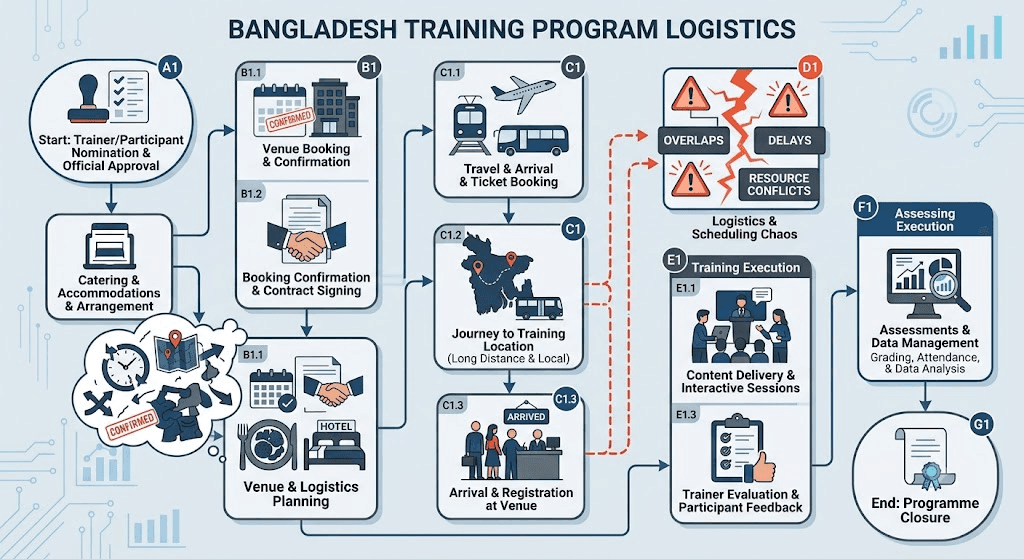
The Bangladesh Directorate of Secondary and Higher Education (DSHE) was responsible for training teachers across 3,000+ colleges. The existing process required:
Physical trainers are travelling to each college
Coordinating venues, dates, and attendance manually
Zero continuity — training happened once, never reinforced
Rural colleges effectively unreachable
"At current capacity, the government would need 50+ years to train every teacher even once."
A quote from a teacher or ministry official: "Teachers we interviewed described going 3-5 years without any professional development."
The Stakeholder Challenge
Stakeholder | Primary concern |
USAID | Measurable development outcomes, grant compliance |
Florida State University | Academic rigour, research validity |
Chemonics International | Implementation feasibility, budget |
Bangladesh Education Ministry | Political viability, teacher adoption |
In practice, we didn't have the luxury of long alignment cycles — the entire prototype had to exist in 21 days. So instead of trying to get all four organisations to agree in meeting rooms, we worked differently: design first, align second.
We produced multiple design directions early and put concrete screens in front of the stakeholders rather than abstract requirements documents. Each organisation could react to something real — USAID could see how their outcome metrics would surface, FSU could check the academic flow, the Ministry could judge whether teachers would actually adopt it.
That approach paid off. The stakeholders reviewed the versions and approved our direction with minimal revision — we went straight into development handoff for testing. With this timeline, getting to a shared decision through working prototypes was the only viable form of stakeholder management.
The Solution
The LMS Architecture
The platform was designed around three core feature suites:
Professional Learning Community (PLC) built on a simple but powerful idea: teachers as both learners and teachers. A teacher would study a module, then other teachers would answer their questions and assess their work — turning 140,000 isolated teachers into a self-sustaining learning network.
Each module followed a structured learning path: an explainer video introducing the topic, a long-form article for deeper reading, a practical task, and finally an assignment to submit. Submissions worked two ways — handwritten work photographed and uploaded, or MCQ assessments completed directly in the platform. That flexibility mattered: many teachers were far more comfortable writing by hand than typing into a web form, so we met them where they already were.
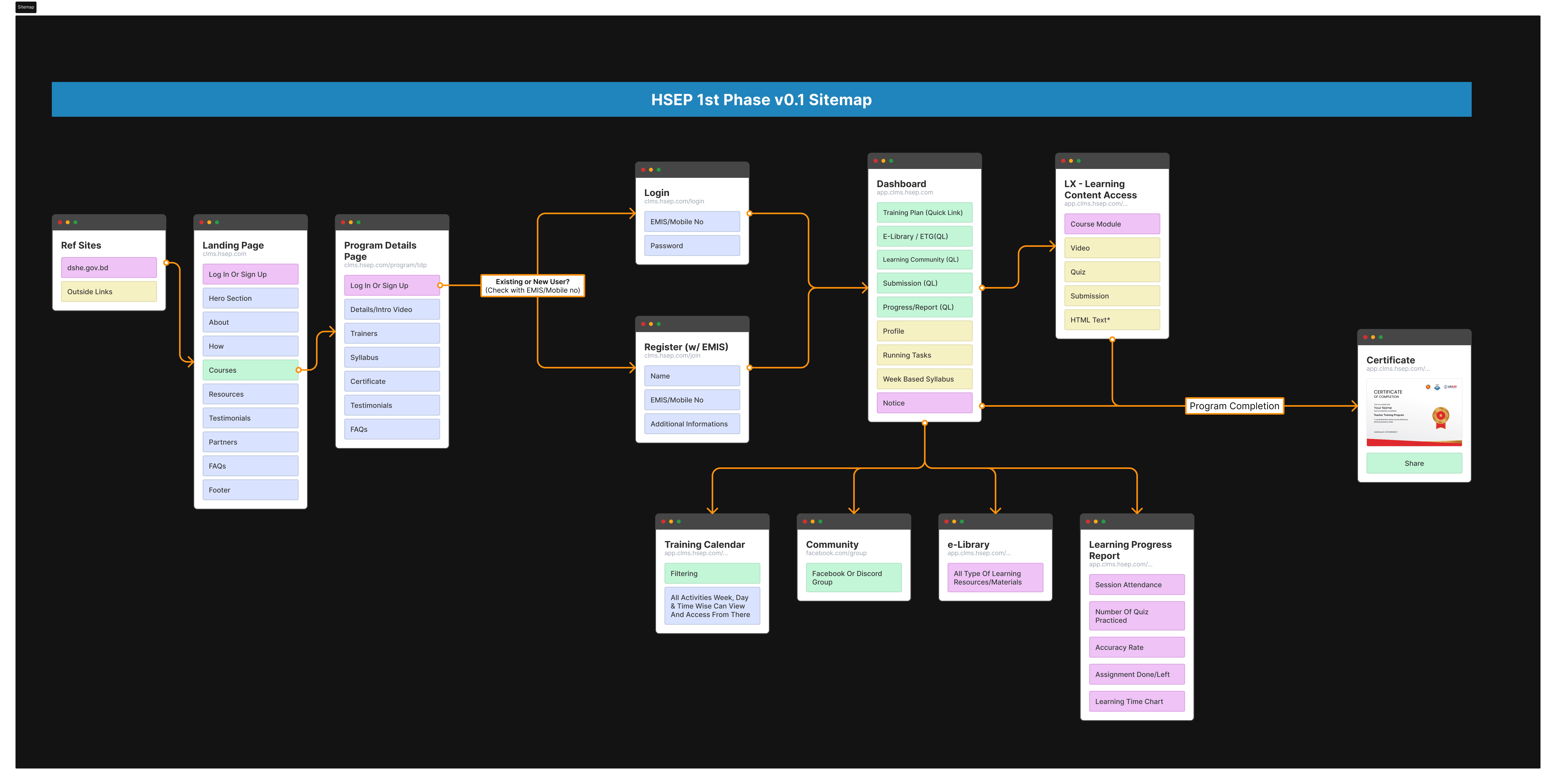
Peer-to-Peer Assessment (P2P) worked much like Coursera's peer-review model: a teacher submits an assignment, and three other teachers are randomly assigned to review and mark it. With no way for 140,000 teachers to be graded by a central pool of examiners, the teachers themselves became the assessment engine — scalable by design.
The design challenge was trust and fairness: random strangers marking each other's work needs structure. Reviewers were guided through the submission with clear marking criteria, so an untrained reviewer could still produce a consistent, defensible score.
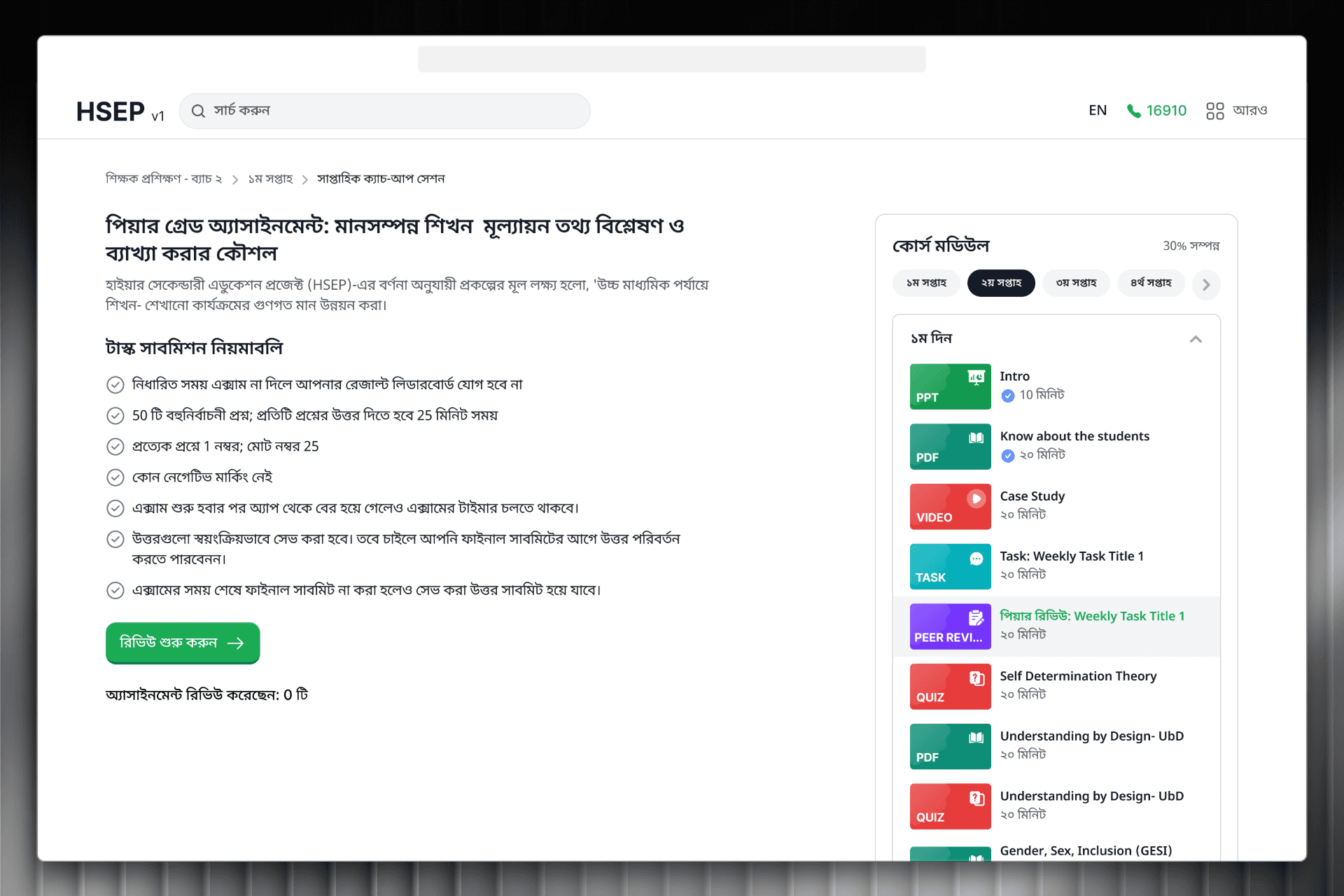
Discussion & Collaboration was a module-specific threaded forum, similar in spirit to Coursera's community boards. Each week, an instructor posted a guided prompt tied to the learning objective — for example, asking teachers to share their opinions on what makes a quality assessment. Learners responded in a dedicated submission box that also supported image attachments for richer context, and everyone could interact through threaded replies and upvotes/downvotes.
For teachers who had spent careers isolated in individual classrooms, this was often the first time they could compare notes with peers across the country. The structure mattered: guided weekly prompts kept discussions on-topic rather than leaving an empty forum nobody would post into.
Design Principles for This Context
These principles were specific to teaching 140,000 teachers across a developing nation—not generic UX principles:
Low-bandwidth first. The goal was connecting teachers across all of Bangladesh — and some regions simply aren't covered by high-speed internet. So the platform was heavily optimised for slow connections: lightweight pages, compressed media, and a UI that stayed usable where bandwidth couldn't be trusted.
Low-end devices, not just low literacy. Many teachers didn't have powerful PCs or laptops either. Every screen was built to deliver a smooth experience on modest hardware — video playback and content loading had to work on whatever device a teacher already owned, not the machine we wished they had.
Fully Bengali. This was a pure Bangla product — not bilingual, not translated after the fact. Every label, flow, and piece of content was designed natively in Bengali, so language was never a barrier between a teacher and their training.
The 21-Day Sprint
This is one of your most compelling sub-stories. Tell it with a timeline:
Days 1-3: Discovery and scope definition with all four stakeholders.
Days 4-7: Information architecture and core user flows.
Days 8-14: High-fidelity design of priority feature suites
Days 15-18: Prototype build and internal testing
Days 19-21: Stakeholder presentation and approval
The hardest constraint wasn't design — it was content. The source material was Bangla books, mostly in legacy Bijoy-encoded text, which couldn't be copied cleanly and defeated every OCR tool we tried. This was also the moment ChatGPT had just launched, so there was no mature AI pipeline to lean on. Moving book content into Figma — and then into HTML for development — became an unexpected bottleneck that ate time no one had budgeted for.
To survive 21 days, we cut ruthlessly toward a true MVP: function before finish. Every screen was designed to prove the core flows worked first; polish came only where it didn't compete with shipping.
What surprised me most, though, came after the sprint: after everything shipped on schedule and got approved, the whole project stopped suddenly. Twenty-one days of compressed, focused work produced exactly what stakeholders asked for — and geopolitics ended it anyway.
Testing With Real Teachers
I wasn't physically in the training rooms — quota limitations meant my design lead and other team members travelled instead, running testing sessions across 5 districts. My role sat on the other side of that pipeline: processing the data coming back from the field. And it surfaced a lot — we came away with a long list of marked improvements.
The clearest finding was age. Teachers spanned generations — some near retirement, some fresh out of college — and an interface tuned to feel modern and friendly for younger users didn't land equally with older teachers. It worked, but the field data made clear the experience needed another iteration pass after MVP to serve the full age range properly.
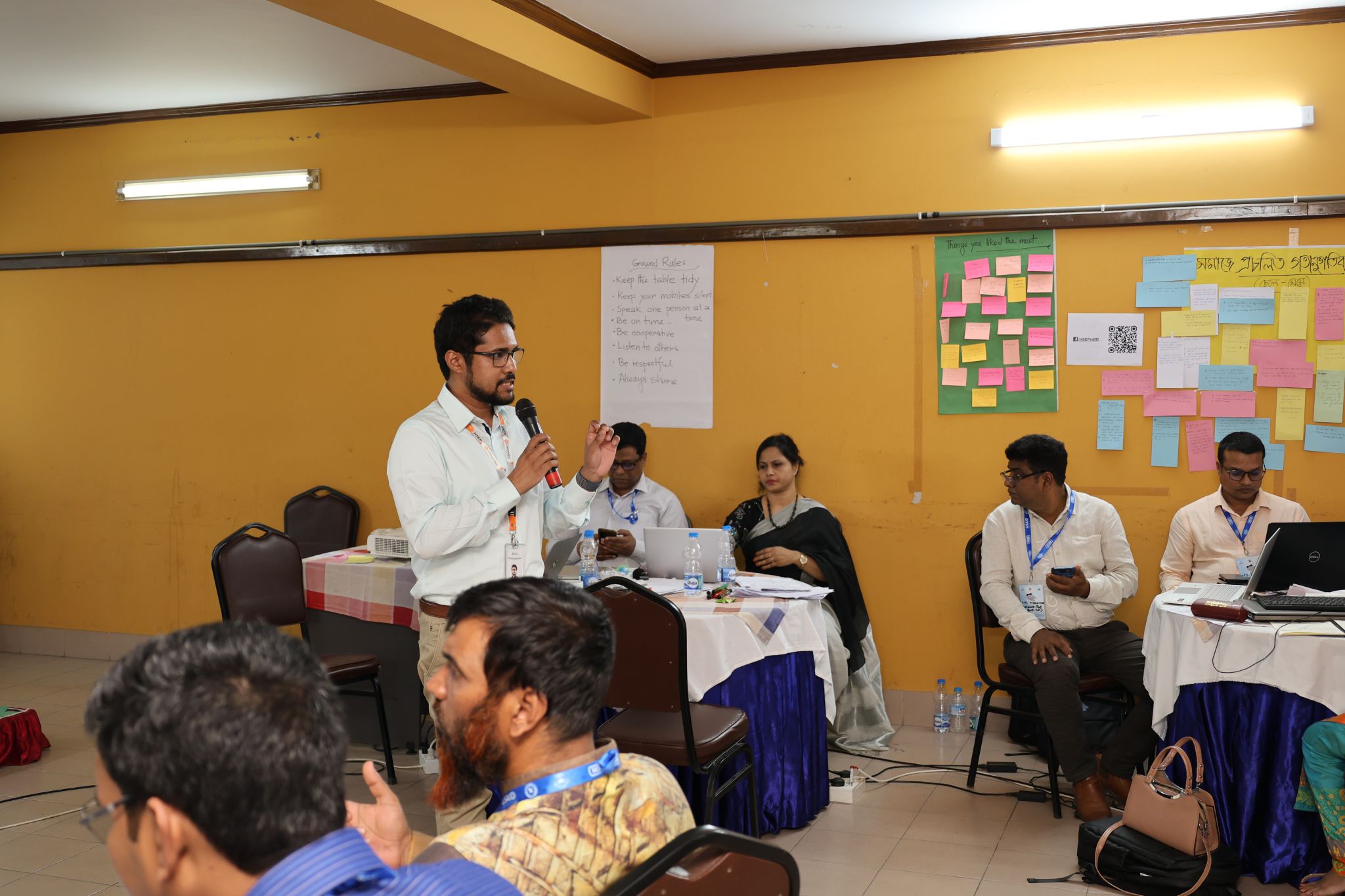
What did 500 master trainee teachers going through the program teach us? That a prototype can survive contact with real users on the first pass — but "works" and "works well for everyone" are different milestones, and only field data shows the gap.
The Outcomes
$3M USAID grant secured through competitive public tender
500 master trainee teachers trained on the platform
21 days: Full prototype designed and approved
3,000+ colleges scoped for national rollout
140,000+ teachers; the platform was designed to reach
Beyond the numbers: the pilot training sessions drew direct positive feedback from the teachers who went through them, and the field data gave the team a clear, prioritised picture of what a post-MVP iteration needed. Perhaps most telling — the platform proved that Bangladesh's national teacher training could realistically move from a 50-year physical pipeline to a digital one. The blueprint exists; it's documented, validated in classrooms across 5 districts, and ready for whoever picks it up next.
The Discontinuation
What happened:
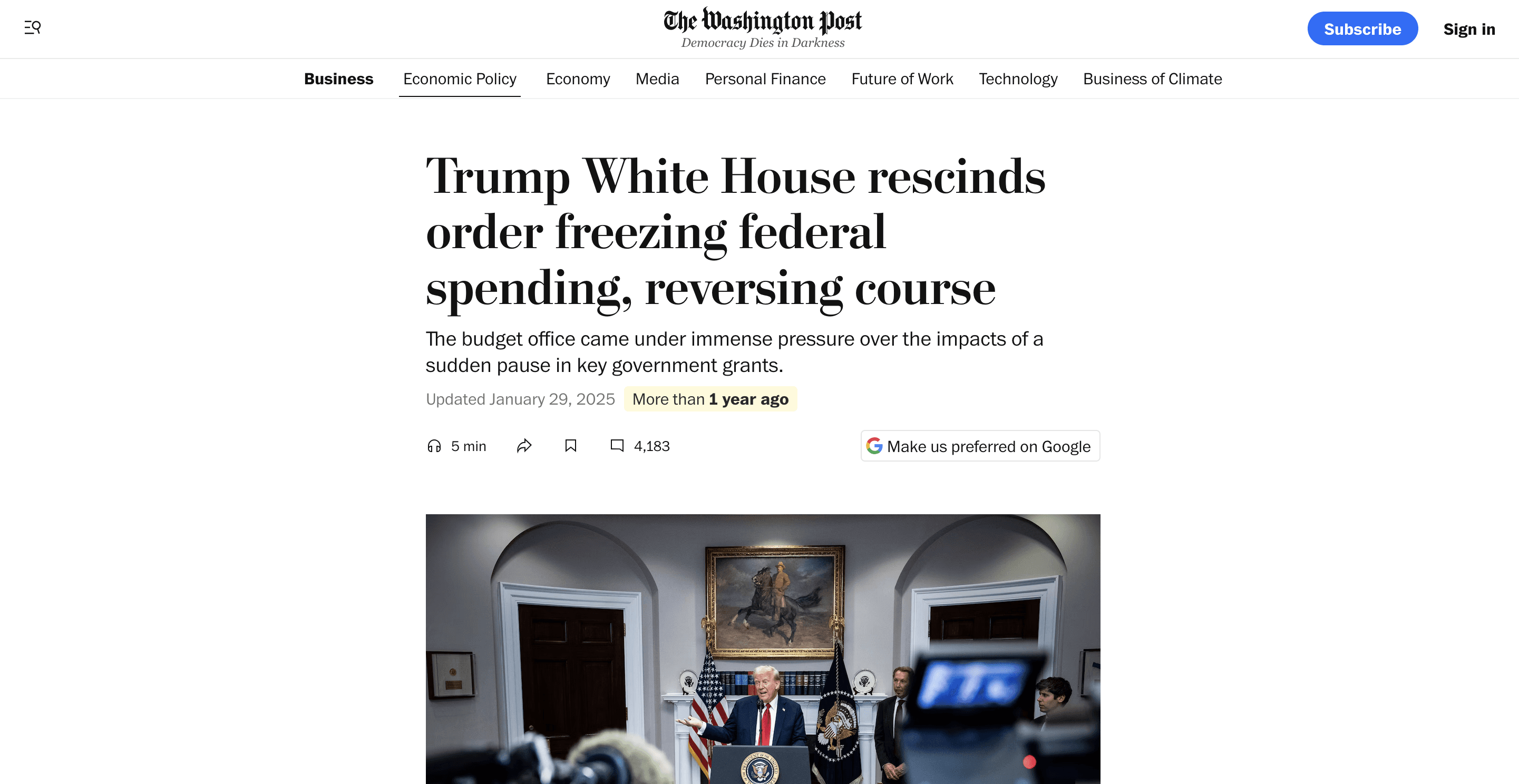
In early 2025, the incoming US administration began dismantling USAID as part of broader federal restructuring. A stop-work order hit USAID-funded projects worldwide on January 24; by February 2025, the HSEP program—along with hundreds of other USAID-funded development initiatives globally—was formally discontinued.
What this means for the case study:
The platform was never deployed at a national scale. The 500 trained teachers exist. The $3M grant was secured and spent on legitimate development work. The design and prototype were approved by all four stakeholders. The project didn't fail — it was stopped by geopolitics entirely outside anyone's control.
I found out through a message in the HSEP Slack channel. No warning, no wind-down — just a stop-work notice. When we got to the office the next day, everyone was a little quiet. Not because of lost revenue or résumé lines — because it was genuinely the most interesting project any of us had worked on: a chance to design at national scale, across four organisations, for every higher-secondary teacher in Bangladesh. We knew exactly what it could have become, and that was the hard part. Some work you grieve briefly and move past. This one still feels unfinished — because for the teachers it was built for, it is.
What I Learned
Three specific lessons, not generic ones:
Designing for government scale is a different discipline. When your users number 140,000 and your clients are four organisations, the hard problems aren't screens — they're constraints you never chose. Bijoy-encoded books no OCR could read, teachers on decade-old hardware, districts without reliable internet. At this scale, design is mostly deciding what to optimise for when you can't optimise for everything.
Stakeholder alignment is a design deliverable. With a 21-day clock, there was no time to align four organisations through meetings — so we aligned them through artifacts. Multiple concrete directions early meant every stakeholder reacted to something real instead of debating abstractions. On fast projects, the prototype is the alignment process. I'd use this approach again; next time I'd start it even earlier.
External forces can kill good work — and that's not failure. We shipped on schedule, got approved by all four stakeholders, trained 500 master teachers across 5 districts. Then geopolitics ended the program overnight. It taught me that "shipped and successful" and "still exists" are different things. What survives from a discontinued project is what you learned and how you worked — and both of those transfer everywhere.